Enrolment
Initial assessment process
The exit assessment is mandatory prior to any registration validation for Category Category B licence training.
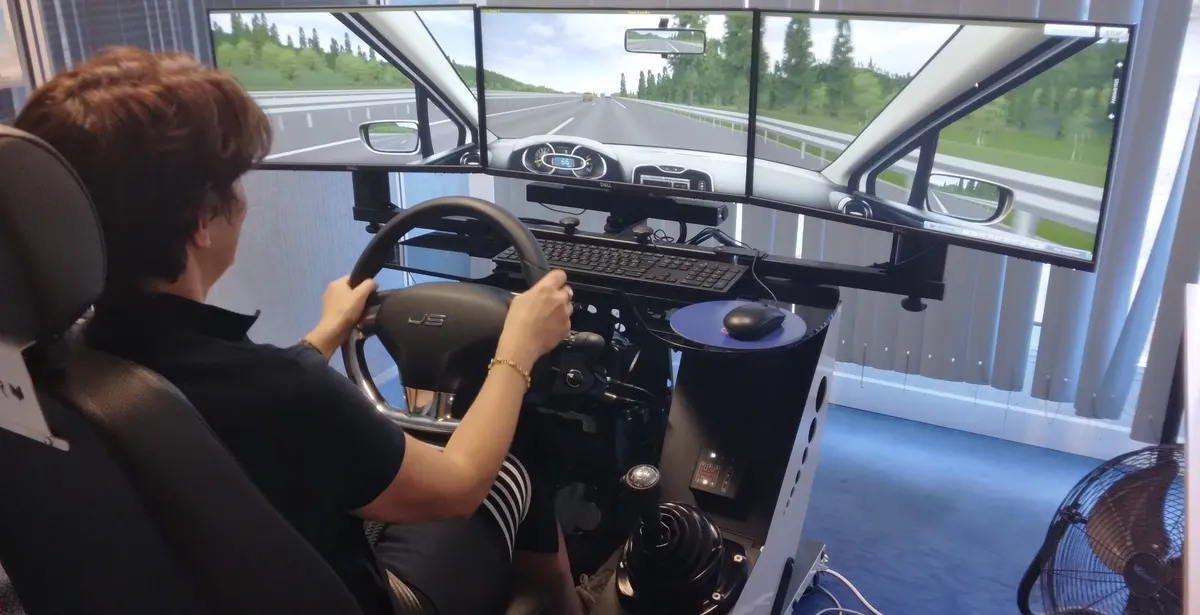
This test takes place with the support of a instructor, then in autonomy on a driving simulator (Stars AE 3.0, manual gearbox).
It is used to quantify the number of hours of driving training. It does not impose a number of hours: it is a forecast. It may be reduced by the student's involvement in the training and by the frequency of hours.
This evaluation will, in consultation with the driving school, make it possible to organise a training schedule.
It breaks down into three parts
- 1
The first concerns identity and gathers some general information on the student's journey.
- 2
The second is the measurement of knowledge about signs and rules of conduct.
- 3
The third measure is mechanical knowledge, skills and visual perception.
The evaluation aims at producing a codified result with 5 levels of performance, leading to 5 tranches of proposals for hourly volumes.
Duration: Approximately 45 minutes
Details of competencies assessed
Download a sample initial assessment report (PDF)| Question Area / Exercises | Criteria assessed |
|---|---|
| Driving experience | Permits held Drived vehicles Zone of evolution on board the vehicle Driving time Accompaniment or autonomous practice |
| Signing knowledge | Ability to identify signs according to their shape. |
| Road code knowledge | Ability to respond to a MCQ in a limited time (series of 20 questions) based on photographs illustrating driving situations. Knowledge of traffic rules, sign significance and transit priorities. |
| Theoretical knowledge of the vehicle | Ability to respond to a QCM with 3 proposals in a limited time, on a series of 12 questions in 4 technical themes: direction, gearbox, clutch, braking. |
| Attitudes towards learning | Hierarchy of reasons for choice of driving school: reputation, offer of training versus price, proximity. |
| Security Attitudes | Hierarchy of attitudes towards safety: limitation to technical and regulatory aspects of driving versus adaptation to context and sharing of road space. |
| Memorization | Ability to memorize a 7 point sequence constituting the installation chronology at the driving station. Sequence read and displayed on screen. The request for restitution shall be made at the end of the assessment. It relies on the request to assign a number to be given to the various elements of the list, presented in disorder, to find the chronology presented at the beginning of the assessment. |
| Skilled (coordination and synchronization of gestures) — start-stops | Understanding: following visual and auditory explanations, the user must perform stop-starts. Comprehensiveness, taking into account the number of explanations that have been required before starting the evaluation. Skilled: ability to use vehicle controls, taking into account the number of errors made during the evaluation of start-stops. |
| Steering wheel handling | The assessment focuses on the ability to track at low speed and by handling the steering wheel to make a slalom course between cones. The brake pedal intervention can impact the result. |
| Trajectory | Assessment of laterality and ability to follow an imposed trajectory. Follow, at an imposed speed, a path drawn on the road. |
| Observation, eyes, emotions | Competency test to measure: the ability to resist social pressure, the ability to observe, anticipate obstacles, to manage the appearances according to the requirements, to manage trajectories, to comply with the signs imposing the stop, to manage communication accessories. Assessment of Perceptive Capabilities and Response Time to Visual Stimulus. The vehicle moves automatically. A target on the trajectory is requested. |
The evaluation is done by appointment, before the validation of your registration.
Book my evaluation